
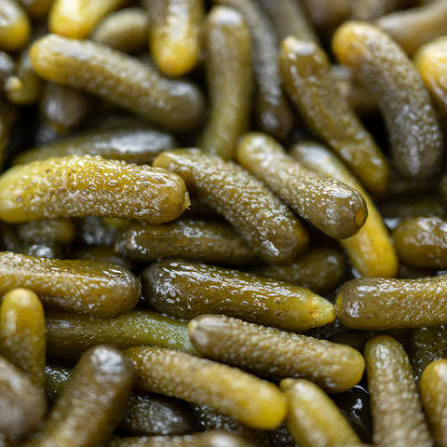
Ask any buyer who has handled more than one container of pickled gherkins, and they will tell you the brine-versus-vinegar decision is rarely as simple as it first looks. It affects taste, shelf handling, packaging, and how the product performs once it reaches the shelf or kitchen at the other end.
Get it wrong at the bulk-order stage, and the cost of that mistake usually shows up later, either in customer complaints or in stock that will not move.
Reputable gherkin exporters typically offer both styles for good reason: different buyers, different end uses, different expectations.
This blog sets out the practical differences between the two, drawing on how the product actually behaves in processing and in transit, so that you walk into your next conversation with a gherkin exporter already knowing the right questions to ask.
Understanding Gherkins in Brine
Brine is a controlled salt-and-water solution, and it remains one of the oldest and most dependable ways to preserve vegetables. The salt solution draws moisture out of the gherkins through osmosis, and because bacteria need moisture to multiply, reduced moisture limits microbial growth and helps preserve the product through long shipping and storage cycles.
A few points worth knowing about brined gherkins:
- Flavour stays close to the natural cucumber taste, with only a mild salt note.
- Many buyers treat brine as a base product, adding their own seasoning, vinegar mix, or spice blend after receiving the shipment.
- Salt concentration has to be monitored closely throughout processing; even small drifts affect texture and preservation.
- Bulk HDPE drums are the standard packaging format, which suits buyers who plan to repack, reprocess, or private-label the product.
Brined gherkins work well for businesses that want control over the final flavour profile rather than receiving a product that is already finished.
Understanding Gherkins in Vinegar
Vinegar-preserved gherkins go through the same cleaning and grading steps as brined gherkins but are packed in a vinegar-based solution, usually with a measured amount of acetic acid, sugar, and spices for the characteristic tangy profile.
A few points worth knowing about vinegar gherkins:
- More flavourful straight out of the jar, with no additional seasoning needed before serving.
- Packaging is generally retail-facing, in jars, bottles, or pouches, though bulk formats are also available on request.
- The acidity extends shelf life once opened compared with brine, but the jar should still be kept refrigerated after opening and used within a reasonable window, not left at room temperature.
- Ready to use straight from the pack, which is why food-service buyers favour it.
Vinegar gherkins are generally the preferred choice for supermarkets, restaurants, and other food-service operations that need a product ready to serve without further preparation.
Comparing the Two at a Glance
The table below sets side by side how brine and vinegar gherkins differ across the factors that matter most at the order stage.
| Feature | Gherkins in Brine | Gherkins in Vinegar |
| Preserving agent | Salt dissolved in water (brine) | Vinegar / acetic acid solution |
| Taste profile | Mild, close to the natural cucumber flavour | Sharp, tangy, ready-to-eat |
| Shelf life once opened. | Shorter window; refrigerate and use promptly | Longer window than brine, but still needs refrigeration after opening |
| Typical packaging | Bulk HDPE drums or pails, 260 litres | Retail jars, bottles, or pouches; bulk drums also available |
| Best suited for | Buyers who repack, season, or reprocess | Buyers who need a finished, shelf-ready product |
| Typical buyers | Food processing and private-label companies | Retailers, restaurants, food-service distributors |
Figuring Out What Suits Your Business
There is no single correct answer here; it comes down to how your operation is set up and what your customers expect on the other end.
If your team blends its own seasoning or runs a private-label line, brine gives you that room to work. If you are running a retail or food-service operation where the product needs to go straight onto a shelf or a plate, vinegar removes a step, sometimes several, from your process.
Shipping distance is rarely the deciding factor on its own; both styles travel well over long routes when packed correctly. What does vary is texture retention after opening; vinegar gherkins tend to hold their crunch a little longer once the jar is opened and refrigerated, which matters for food-service buyers plating the product directly.
Market taste preference also plays a role. Some regions favour the milder, closer-to-natural taste of brine; others expect the sharper, tangier profile that vinegar delivers.
One detail that gets missed more often than it should: size grading. Gherkins are graded by size depending on whether they will be sliced, packed whole, or used as a garnish, and this should be settled before the purchase order is placed, not after the container has shipped.
What to Ask Before You Commit to a Bulk Order
Before signing off on a large shipment, it is worth getting clear, specific answers on:
- How gherkins are graded by size and quality, and which grades are available.
- Whether washing, grading, and packaging follow recognised food safety standards such as FSSAI, FSSC 22000, or equivalent international certifications.
- Whether the exporter can supply both brine and vinegar, depending on how your order is structured.
- What packaging formats are offered for bulk shipping, including drum sizes included?
- Whether the exporter has shipped to your country before, and can speak to the documentation that route requires.
None of these questions takes long to ask, but skipping them is how avoidable problems end up surfacing once a shipment is already in transit.
Indo Western Agro Exports (IWAE): A Sourcing Partner Built on Process
Indo Western Agro Exports (IWAE) operates out of Sira Taluk in Karnataka, India, and has built its export business around consistency in grading, hygiene, and documentation rather than volume alone. The company processes and exports Gherkins, Banderillas, Jalapenos, Bell Peppers, Chillies, Baby Corn, and Peppercorn to buyers across several continents.
Among gherkin exporters offering both preservation styles, IWAE supplies gherkins in vinegar and gherkins in brine, matched to whatever a buyer’s order specification calls for, along with gherkins packed in acetic acid and preserved gherkins in bulk drums and pails.
What Makes IWAE a Trusted Bulk Sourcing Partner
- Production follows Good Agricultural Practices (GAP) and Good Manufacturing Practices (GMP) at every stage, from farm to final pack.
- Quality systems are aligned with FSSC 22000 and FSSAI certification, along with Kosher certification, and are built to meet USFDA and European Union food safety norms.
- Cleaning, grading, soaking, and washing are carried out under close quality-control supervision, not checked only at final inspection.
- Gherkins are available across multiple size grades, including 300+, 150/300, 100/160, 80/120, 60/160, 60/100, 30/60, 30/40, 20/30, 10/30, and 10/20, packed in 260-litre food-grade HDPE drums, with grading adjusted to a buyer’s specification where needed.
- Pre-shipment inspections are standard practice before a container leaves the facility.
- Current export destinations include the UK, US, Australia, France, Germany, Greece, Italy, the Netherlands, Poland, Russia, South Korea, Spain, Sweden, and the UAE.
As a high-quality gherkin processing company, IWAE also handles other pickled vegetables, including Jalapenos, Bell Peppers, and Baby Corn, so buyers who would rather consolidate sourcing with one supplier instead of several have that option on the table.
Final Thoughts
Choosing between gherkins in brine and gherkins in vinegar comes down to what your business actually needs to do with the product, not which one is objectively better. Brine gives buyers room to build their own flavour later in the process; vinegar delivers a product that is ready for the shelf or the kitchen as soon as the jar is opened, provided it is refrigerated once opened, just like any acidified food product.
Whichever style suits your operation, sourcing from a gherkin exporter that maintains consistent grading, verified certifications, and dependable documentation makes the ordering process considerably easier to manage from quotation to delivery.
For buyers looking for a reliable partner that can supply either option at export scale, Indo Western Agro Exports (IWAE) is worth including in your next round of supplier conversations.

